012 Cognitive modeling
Computational Representation of Alzheimer’s Disease Evolution for a Cooking Activity
This project aims to build a computational model of cognitive processes involved in activities of daily living (ADL), with the cognitive architecture ACT-R.
Objectives
To be as coherent as possible, the model must be based on psychological observations. We decided to build our model on observations made during a particular occupational therapy assessment: the Kitchen Task Assessment, KTA (Baum & Edwards, 1993).
The objectives are:
- to identify the cognitive processes involved in the completion of daily living tasks, and simulate the completion of an ADL using the ACT-R cognitive architecture.
- to represent errors in terms of both the type of cognitive disorder at the root of the error and the support needed when the error occurs (in the KTA, the seriousness of an error is measured by evaluating the level of support needed to overcome it).
Model description
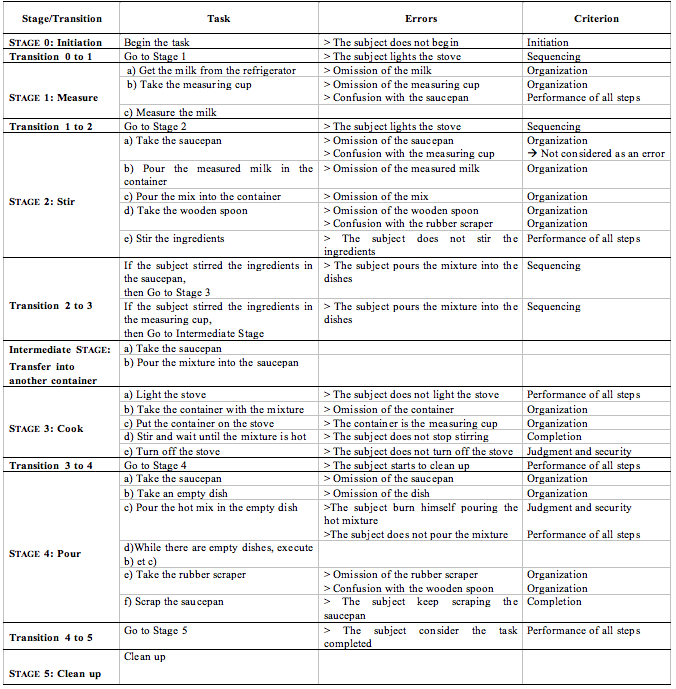
The specific ADL of the KTA is the preparation of a pudding from a commercial package. The recipe has four major steps: measure the ingredients, stir them, cook the mixture on the stove and pour the hot mixture into four dishes.
To grade the subjects’ performance, the assessment uses six criteria:
- initiation (Can the person begin the task?)
- organization (Can the person gather the items necessary to perform the task?)
- performance of all steps (Can the person perform all the steps necessary to complete the task?)
- sequencing (Can the person sequence the activities that make it possible to complete the task?)
- judgment and safety (Is the person safe in performing the task?)
- completion (Does the person know when he or she is finished with the task?)
The model that we developed simulates the activity process and the different typical errors committed by subjects with Alzheimer's disease. The following table presents the organization of the model and the different errors simulated.
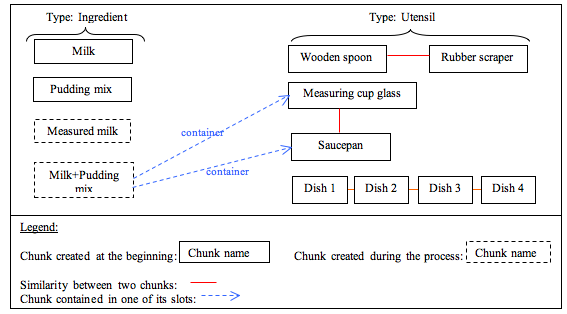
Declarative memory:
In the KTA, the task to perform is a cooking activity with which all the subjects are familiar. At the beginning of the experiment, declarative memory holds knowledge about ingredients and utensils already known by the subjects. New elements, such as the measured milk or the mixture, are added during the process by means of the working memory.
The six subtasks in the recipe are represented by six specific goals in the model (a intermediate stage is executed when the subject stir the ingredients in the measuring cup instead of the saucepan).
| Initiate | state | ||||||||
| Measure | ingredient | ustensile | state | ||||||
| Stir | container | ingredient1 | ingredient2 | ustensile | state | ||||
| Transvase | new-container | state | |||||||
| Cook | ingredient | container | ustensile | state | stove-state | ||||
| Pour | state | container | first-dish | second-dish | third-dish | fourth-dish | current-dish | ustensile | dishes-state |
| Clean | state | previous-stage |
Example of creation of a particular goal for the cooking stage during the simulation:
| Cook | milk+pudding-mix | saucepan | wooden-spoon | ready-to-proceed | off |
Goals are created along the process via the transition process (see procedural memory for more detail). During this process the next goal is selected. To reproduce sequencing errors, erroneous goals can be created:
| Light-Stove | state | previous-goal |
| Pour-Cold-Mix | state | transition |
| Task-Completed | state | previous-goal |
Procedural memory
Each stage of the recipe’s basic actions has been coded as a production rule, stored in procedural memory.
Number of rules in the model: 152 production rules.
Retrieval of an element
During the completion of an ADL, when subjects want to retrieve an ingredient or a utensil, they first access a representation of the object in their memory, and then search for its location in their environment, identify it and finally pick it up. In this model, the perceptual and motor parts of the action of retrieving have not been simulated. It is assumed that accessing the representation in memory automatically simulates the action of retrieving and the cognitive errors associated with that action. In ACT-R, this corresponds to a retrieval request in declarative memory.
RETRIEVE_MILK IF the goal is to measure and the state is ready to proceed THEN set state to find the milk and retrieve milk |
RETRIEVE_MEASURING_CUP IF the goal is to measure and the state is to find the milk and the milk is retrieved THEN set state to find the measuring cup and retrieve mesuring cup |
Transition to another step of the recipe
When a subject has completed a particular stage of the recipe, that person has to plan which sequence to execute next. In this model, this is represented by a transition system where the current goal is changed. The production rule leads to the creation of the following goal.
TRANSITION_0_1 IF the goal is to initiate and the state is complete THEN create a new goal to measure the milk using the measuring cup |
Errors modeling
Omission and commission errors modeling
Omission errors refer to the subjects’ incapacity to recall certain elements. In ACT-R, omission errors are simulated when a chunk cannot gather enough activation to be retrieved above the fixed threshold value.
Confusion errors, also called commission errors, occur when a subject makes a mistake by picking up one utensil instead of another. Within the ACT-R framework, allowing imperfect matching in the production system can account for errors of commission. This mechanism permits the retrieval of a chunk that only partially matches the current pattern (instead of the correct chunk).
Behavior errors modeling
Behavior errors can be seen as poor choices among different strategies. When faced with a particular situation, subjects adopt different types of behavior and each type of behavior can be seen as a strategy. These strategies are implemented in procedural memory by means of different rules that can be applied to a particular situation. The modeling of behavior errors in ACT-R is therefore done by creating a conflict situation between a rule controlling normal behavior and a rule controlling an incorrect action.
| (a.1) TRANSITION_0_1 IF the goal is to initiate and the state is complete THEN create a new goal to measure the milk using the measuring cup |
(a.2) TRANSITION_0_1_ERROR1 IF the goal is to initiate and the state is complete THEN create a new goal to light the stove |
Parameters values
Parameters values common to every level of dementia
| Equation | Parameter | Value | Chunk activation | Transitory noise ε | 0.03 |
| Chunk activation | Strengths of association S | 2.0 |
| Production utility | Transitory noise ε | 1.5 |
Parameters values depending on the level of dementia
Cognitive deficits increase as Alzheimer’s disease progresses and errors in ADL execution occur at a higher rate with severe dementia. This progression of the disease is modeled in ACT-R through changes in the subsymbolic parameters that model the level of cognitive abilities.
| Dementia level | Error type | Parameter | Value |
| CDR 0 | Omission | Source activation: W | 1.0 |
| Confusion | Partial matching Scale: Pk | 2.0 / n | |
| Behavior error | Successes number: successes | 100 | |
| Behavior error | Failures number: failures | 0 | |
| CDR 0.5 | Omission | Source activation: W | 0.74 |
| Confusion | Partial matching Scale: Pk | 3.97 / n | |
| Behavior error | Successes number: successes | 59 | |
| Behavior error | Failures number: failures | 41 | |
| CDR 1 | Omission | Source activation: W | 0.68 |
| Confusion | Partial matching Scale: Pk | 4.15 / n | |
| Behavior error | Successes number: successes | 53 | |
| Behavior error | Failures number: failures | 47 | |
| CDR 2 | Omission | Source activation: W | 0.61 |
| Confusion | Partial matching Scale: Pk | 4.25 / n | |
| Behavior error | Successes number: successes | 46.5 | |
| Behavior error | Failures number: failures | 53.5 | |
| CDR 3 | Omission | Source activation: W | 0.60 |
| Confusion | Partial matching Scale: Pk | 4.45 / n | |
| Behavior error | Successes number: successes | 41 | |
| Behavior error | Failures number: failures | 59 |
Results
The system is able to simulate the behavior of a single subject. Each step involved in ADL execution is observed and potential problems are located.
|
**** Stage 4: Pour **** |
To run the model, the user has to choose to simulate a trial of 1 or 100 subjects (command kta or kta100) and the level of dementia that he wants to simulate (according to the CDR). The different commands to execute the model are:
| (kta "CDR-0") | (kta100 "CDR-0") |
| (kta "CDR-0.5") | (kta100 "CDR-0.5") |
| (kta "CDR-1") | (kta100 "CDR-1") |
| (kta "CDR-2") | (kta100 "CDR-2") |
| (kta "CDR-3") | (kta100 "CDR-3") |
The system is also able to simulate the behavior of 100 subjects, giving the overall average score obtained and the distribution of the subjects’ results under each criterion. For example, the following table lists the results of a simulation of 100 people with a questionable dementia. 62 people are able to sequence the activity on their own, 34 require verbal cues, 4 require physical assistance but none of them are incapable of sequencing the task.
| Criterion | Independant | Verbal help | Physical help | Not capable |
| Initiation | 99 | 1 | 0 | 0 |
| Organization | 61 | 37 | 2 | 0 |
| All steps | 52 | 38 | 10 | 0 |
| Sequencing | 62 | 34 | 4 | 0 |
| Judgment - safety | 77 | 21 | 2 | 0 |
| Completion | 98 | 2 | 0 | 0 |
| Average score: 1.69 | ||||
The results for 100 simulated subjects can been compared to the results presented in the KTA paper for 106 subjects, thanks to the following table :
| Stage of the disease | KTA results | SD for KTA results | Model results, running 100 times | SD for model results | |
| CDR 0 | Without dementia | - | - | 0.01 | 0.099 |
| CDR 0.5 | Questionable dementia | 1.75 | 2.21 | 1.69 | 1.119 |
| CDR 1 | Mild dementia | 4.65 | 3.73 | 4.52 | 1.723 |
| CDR 2 | Moderate dementia | 9.81 | 4.57 | 9.87 | 2.339 |
| CDR 3 | Severe dementia | 13.88 | 4.61 | 13.84 | 2.419 |
Model
The model has been developed with ACT-R 5.
Publications on the model
Serna A, Rialle V et Pigot H. (2006). Computational Representation of Alzheimer's Disease Evolution Applied to a Cooking Activity. Proceedings of MIE 2006: 20th International Congress of the European Federation for Medical Informatics. 27-30 August 2006, Maastricht, the Netherlands. pp 587-592.
Best paper award: Peter L. Reichertz’ Award for Young Scientitsts.